Training Guide
How to Choose 5/3/1 Assistance Work for Maximum Hypertrophy
A technical guide to selecting Push, Pull, and Single Leg/Core accessories for 5/3/1 without accumulating junk volume or overtraining.

Most lifters nail the main work. They hit their sets, log their PRs, and move on. The assistance work is where it falls apart — either ignored entirely, or turned into a bodybuilding free-for-all that bleeds recovery away from the lifts that actually matter.
Wendler’s framework is explicit: assistance work exists to build the muscles that support the main lifts, address weaknesses, and accumulate hypertrophy volume without competing with the primary stimulus. Get the selection and volume wrong and you’re either leaving muscle on the table or digging a fatigue hole you’ll spend weeks climbing out of.
This guide covers how to structure your Push, Pull, and Single Leg/Core categories within the 5/3/1 framework — what to pick, how much to do, and how to adjust based on the template you’re running.
The Role of Assistance Work in the 5/3/1 Framework
Wendler programs assistance work through three categories: Push, Pull, and Single Leg/Core. Every training day draws from these categories in varying combinations depending on the template. The organizing principle isn’t exercise selection — it’s total rep volume.
The general prescription:
- 50–100 reps per category per session (the “Joker” and standard template range)
- Some templates compress this to 25–50 reps when the main supplemental work is already significant (e.g., 5x10 in BBB)
- The rep target is a ceiling, not a floor — stop when quality degrades
This isn’t arbitrary. The rep ranges are high enough to drive hypertrophy through mechanical tension and metabolic stress, but structured in a way that keeps the total systemic load manageable. Assistance work should be hard enough to feel productive and easy enough that it doesn’t impair your next session.
The critical rule: Assistance work does not get heavier over time in the same way main lifts do. You’re not chasing PRs here. You’re accumulating quality reps.
Push Category Essentials
The Push category covers any horizontal or vertical pressing movement that isn’t your main lift for the day. On a squat or deadlift day, this is your primary upper body stimulus. On a press or bench day, it supplements what you just trained.
Primary Push movements:
| Exercise | Best Fit | Notes |
|---|---|---|
| Dips (weighted or bodyweight) | Any day | High chest/tricep overlap; excellent hypertrophy driver |
| Dumbbell Bench Press | Squat/Deadlift days | High ROM, independent arm loading |
| Dumbbell Overhead Press | Bench/Deadlift days | Shoulder health and overhead strength carryover |
| Tricep Extensions (DB or cable) | Any day | Direct tricep volume; low systemic cost |
| Pushups (weighted vest or feet elevated) | Deload or volume accumulation | Surprisingly effective at 50+ reps |
Selection logic: On days where the main lift is already pressing (bench, OHP), push assistance should shift toward tricep-dominant movements. You’ve already loaded the chest and anterior delt significantly — extensions and close-grip variations let you add volume without redundant stress on the same motor patterns.
On lower body main lift days (squat, deadlift), push assistance can be more aggressive. A dumbbell bench or weighted dip session running 4x15–25 fits cleanly because the upper body is relatively fresh.
Target: 50–100 total reps. For dips, that might be 4–5 sets to near-failure. For tricep extensions, it’s 3–4 controlled sets of 15–20.
Pull Category Essentials
Pull assistance is where most lifters underinvest. Pressing movements dominate gym culture, and pull volume tends to get shortchanged. In a properly structured 5/3/1 program, pull volume should match or exceed push volume over the course of a training week.
Primary Pull movements:
| Exercise | Best Fit | Notes |
|---|---|---|
| Chin-ups / Pull-ups | Any day | The gold standard; vertical pull with high lat activation |
| Barbell or DB Rows | Any day | Horizontal pull; direct upper back and elbow flexor work |
| Cable Rows | Any day | Consistent tension curve; good for higher rep sets |
| Face Pulls | Every day | Rear delt and external rotator health; should be non-negotiable |
| Band Pull-Aparts | Every day | Low cost, high return for shoulder health |
Chins and rows are the backbone. Wendler’s own writing consistently emphasizes these two. If you do nothing else in the pull category, chin-ups and rows — done consistently, over years — will build the upper back thickness and arm size that most lifters chase with curls and isolation work.
Face pulls and band pull-aparts deserve their own mention. These aren’t vanity work. Heavy pressing concentrated over years without adequate external rotation volume is a direct path to shoulder pathology. Running 2–3 sets of face pulls (15–20 reps) on every training day costs almost nothing in recovery and pays back substantially in shoulder longevity.
Target: 50–100 total reps. For chins, that might be 5 sets to failure. For rows, 4x15–20 with controlled eccentrics. Face pulls run in addition to the primary pull volume — treat them as maintenance, not the primary stimulus.
Single Leg and Core Category
This category is frequently misunderstood. “Core work” in the 5/3/1 context doesn’t mean crunches and planks — it means anti-rotation, anti-extension, and bracing under load. Single leg work addresses the unilateral strength deficits and hip stability that bilateral squats and deadlifts can’t fully develop.
Recommended movements:
- Single-leg work: Lunges, Bulgarian split squats, step-ups, single-leg RDLs
- Core: Ab wheel rollouts, hanging leg raises, Pallof press, weighted carries (farmer’s, suitcase)
On a press-dominant day, a set of lunges and some rollouts keeps lower body frequency high without adding heavy spinal loading. On a squat or deadlift day, keep single leg volume moderate — your legs are already working.
Balancing Fatigue and Recovery
Selecting the right exercises is half the problem. The other half is knowing when to pull back.
The most common mistake intermediate lifters make with 5/3/1 assistance work is treating it like a fixed prescription regardless of how the main lift went. It isn’t. Wendler’s approach is built on auto-regulation — a concept that applies to assistance volume just as much as intensity.
Key Auto-Regulation Rules
1. Pull volume is the last to cut, first to add. Pull work is generally lower in systemic cost than push work — rows and chin-ups don’t tax the CNS the way heavy pressing does, and they contribute to joint health and postural resilience. When fatigued, keep pull volume intact and trim push and single-leg work first.
2. Match assistance intensity to the training week. Week 3 (the heavy, 5/3/1+ week) accumulates the most fatigue. Assistance volume on Week 3’s final session should be conservative. Week 1 (the 5s week) has the most room for higher-rep assistance work.
3. The quality threshold beats the rep target. If form breaks down at rep 40 on dips, stopping at 40 is correct. Grinding out 60 ugly reps to hit the number defeats the purpose. Hypertrophy is driven by proximity to failure with controlled mechanics — not accumulated junk reps.
4. Sleep and life stress are part of the equation. Poor sleep, work stress, and under-eating all reduce your recoverable volume. A lifter running on six hours of sleep and a caloric deficit should not be pushing 100-rep assistance sessions. This is obvious advice that most lifters consistently ignore.
Sample Assistance Protocols for BBB and FSL
Different 5/3/1 supplemental templates create different assistance demands. The two most popular — Boring But Big (BBB) and First Set Last (FSL) — require different assistance approaches because the supplemental work itself varies significantly in volume and fatigue cost.
Boring But Big (BBB)
BBB runs the main lift’s supplemental sets at 5×10 with 50–60% of training max. This is substantial volume concentrated on the main movement pattern. Your assistance work needs to complement without duplicating.
BBB Squat Day:
| Category | Exercise | Sets × Reps |
|---|---|---|
| Push | DB Bench Press | 4 × 15 |
| Pull | Chin-ups | 4 × max (aim for 40–50 reps) |
| Pull | Face Pulls | 3 × 20 |
| SL/Core | Ab Wheel Rollouts | 3 × 10 |
Why this pairing: The 5×10 squat volume has already loaded the lower body heavily. Single-leg work is minimized. Upper body push and pull fill the gap without adding spinal compression.
BBB Bench Day:
| Category | Exercise | Sets × Reps |
|---|---|---|
| Push | Tricep Pushdowns | 3 × 20 |
| Pull | Barbell Row | 4 × 15 |
| Pull | Band Pull-Aparts | 3 × 25 |
| SL/Core | Lunges | 3 × 10/leg |
Why this pairing: After 5×10 bench, the anterior delt and chest have taken significant volume. Push assistance shifts to tricep isolation. Rows balance horizontal pressing. Lunges address single-leg without added upper body demand.
BBB Deadlift Day:
| Category | Exercise | Sets × Reps |
|---|---|---|
| Push | DB Overhead Press | 3 × 15 |
| Pull | Chin-ups | 5 × max |
| Pull | Face Pulls | 3 × 20 |
| SL/Core | Suitcase Carry | 3 × 30m/side |
Why this pairing: Deadlift 5×10 is brutally fatiguing for the posterior chain. Keep SL work minimal and carry-based (no bilateral loading). Vertical pull is strong here since horizontal rowing would add to an already-taxed lower back.
BBB OHP Day:
| Category | Exercise | Sets × Reps |
|---|---|---|
| Push | Dips | 4 × 15–20 |
| Pull | DB Row | 4 × 15 |
| Pull | Face Pulls | 3 × 20 |
| SL/Core | Bulgarian Split Squat | 3 × 10/leg |
First Set Last (FSL)
FSL runs the first working set weight for multiple sets of 5 (typically 3–5 sets). The volume is lower than BBB, and the intensity is moderate. This creates more recovery headroom for assistance work, meaning you can push closer to the higher end of the 50–100 rep range.
FSL allows more aggressive assistance selection — particularly on lower body days where the supplemental volume isn’t grinding through 5×10 squats or deadlifts.
FSL Squat Day:
| Category | Exercise | Sets × Reps |
|---|---|---|
| Push | DB Bench Press | 4 × 15–20 |
| Push | Tricep Extensions | 3 × 20 |
| Pull | Chin-ups | 5 × max |
| Pull | Face Pulls | 3 × 20 |
| SL/Core | Bulgarian Split Squat | 3 × 10/leg |
| SL/Core | Ab Wheel | 3 × 10 |
FSL Deadlift Day:
| Category | Exercise | Sets × Reps |
|---|---|---|
| Push | DB Overhead Press | 4 × 15 |
| Pull | Barbell Row | 4 × 15 |
| Pull | Band Pull-Aparts | 3 × 25 |
| SL/Core | Single-Leg RDL | 3 × 10/leg |
| SL/Core | Pallof Press | 3 × 12/side |
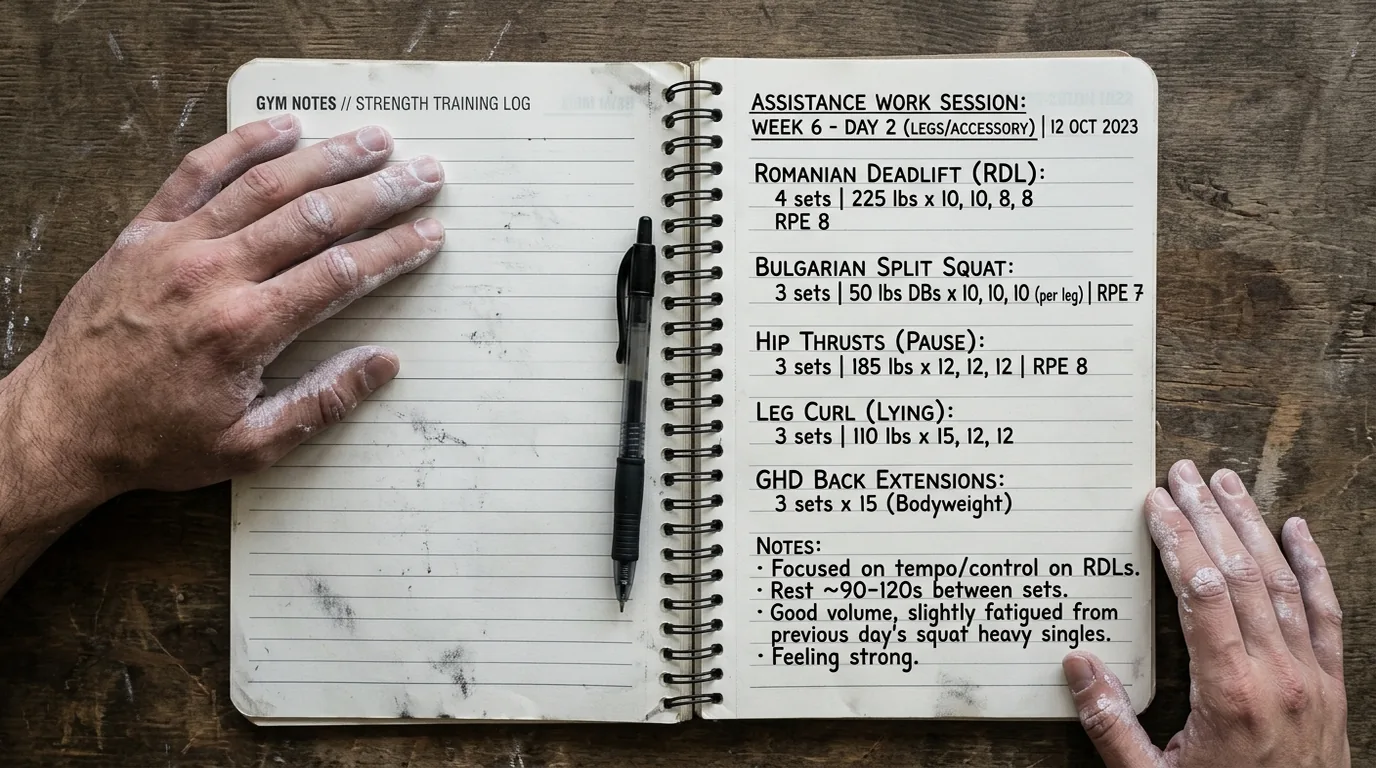
Putting It Into Practice
Assistance work in 5/3/1 isn’t decoration. It’s a structured layer of volume designed to build the muscle mass and movement capacity that makes your main lifts progress over years, not just weeks.
The principles are straightforward:
- Match assistance volume to supplemental volume — more supplemental work means less assistance, not more total work
- Prioritize pull volume — most lifters under-pull relative to how much they push
- Auto-regulate based on how the main lift felt — the rep targets are a guide, not a mandate
- Use the categories as a framework, not a checklist — one solid push and one solid pull per session is enough if the quality is there
If you’re running 5/3/1 through Train531, your assistance work can be logged alongside your main lifts, letting you track cumulative volume across the training month and identify where you’re consistently under- or over-serving a category. The data will tell you things your gut won’t.
Try Train531 Free
AI-powered 5/3/1 coaching. 10 workouts free, no credit card required.
Download on the App Store