Training Tips
Breaking Plateaus: When to Reset Your 5/3/1 Training Max
Learn to identify a stalling 5/3/1 training max, when to reset, and use data tracking to break plateaus before they stop your progress.

There’s a version of plateau that’s dramatic: you miss a rep, slam the bar, and know something has gone wrong. Then there’s the version that actually happens to most lifters — a slow, quiet erosion where your last set feels harder than it should, your rep counts stop climbing, and you keep telling yourself you’re just having a bad week.
That second version is more dangerous. It can persist for months before you acknowledge it.
The 5/3/1 program is designed with long-term progression as its core mechanic. Jim Wendler built it around the premise that small, consistent gains beat aggressive loading every time. But that design only holds if you respect one of its least glamorous features: the training max reset. When your training max climbs too high — and it will, eventually — the entire system stalls. Understanding when to step back, and by how much, is what separates lifters who stay in the program for years from those who burn out in two cycles.
The Myth of Linear Progression
Intermediate and advanced lifters don’t get stronger every week. That’s not a mindset problem — it’s physiology.
Linear progression works for beginners because they’re learning movement patterns and triggering adaptation in a nervous system that has never encountered that specific stimulus. Add 5 lbs, recover, repeat. But once you’ve been training seriously for 12–18 months, your body has adapted to the general stress of lifting. Marginal gains require more precise loading, better recovery, and longer adaptation windows.
This is the entire reason 5/3/1 uses a wave-loading structure across a four-week cycle rather than adding weight every session. The program acknowledges biological reality: you progress across months, not sessions. Your training max increases by 5 lbs (upper body) or 10 lbs (lower body) every cycle — modest numbers that compound into significant progress over a year without outpacing your ability to recover.
The problem is that lifters often treat the training max increase as automatic. Finish a cycle, add the prescribed weight, move on. This works until it doesn’t. And when the TM creeps too high, every subsequent cycle is built on a flawed foundation. Week 3’s 1+ set at 95% of a falsely inflated TM stops being a performance opportunity and becomes a grinding survival test.
Signs Your Training Max Is Too High
A training max that has outpaced your actual strength doesn’t announce itself cleanly. Here are the signals to watch for — in rough order of how early they appear.
Bar Speed Is Slowing on Sets That Shouldn’t Feel Heavy
This is the earliest indicator and the one most lifters miss. On Week 1 (the 5s week), your 75% and 85% sets should move quickly. If your 75% set feels like a grind, something is wrong at the foundation. Your TM has likely drifted above your true max, compressing the percentages into territory that’s heavier than intended.
Slow bar speed on submaximal sets is not a bad day. It’s data.
You’re Grinding or Missing Reps on the 1+ Week
The Week 3 top set at 95% of your TM should be hard — it’s designed to be. But “hard” means serious effort with solid technique, not a slow-motion struggle where form breaks down after rep one.
If you’re hitting 1–2 reps when you were previously hitting 4–5, the lift has stalled. If you’re failing outright, you’ve been ignoring earlier warning signs for several cycles.
The Overhead Press Is the First to Show It
The overhead press is the most common lift where intermediate lifters first encounter a genuine plateau. Its ceiling is lower than the squat or deadlift, the strength curve is less forgiving, and recovery demands from other pressing work compound quickly. A lifter who is still making squat and deadlift progress may have a completely stalled overhead press TM sitting 10–20 lbs above what they can actually sustain.
5/3/1 stalling on overhead press is the canary in the coal mine. When it stalls first, it usually means total recovery capacity is stretched — not that you need to specialize in pressing. Address the TM, assess your supplemental volume, and watch whether the other lifts follow.
Assistance Work Feels Disproportionately Hard
When your TM is too high, your main work takes more out of you than it should. The consequence shows up in your supplemental sets and assistance work — exercises that previously felt manageable suddenly feel crushing. If your FSL sets or your BBB work have become the hardest part of training, your main work is taking too big a bite out of recovery.
Resetting Your Training Max
When a reset is warranted, the math is simple and the execution should be equally simple. Wendler’s prescribed approaches include the “5 forward, 3 back” protocol — advancing 5 cycles and then resetting the Training Max to the level it was 3 cycles prior — or using the 7th Week Protocol to test your current strength and reset the TM to 85–90% of a fresh 1RM. Both methods accomplish the same thing: dropping your TM back into territory where the prescribed percentages are honest again.
If your current overhead press TM is 185 lbs, a reset lands you somewhere in the 155–165 lb range depending on the method used. You will spend several cycles feeling like you’re leaving progress on the table. You are not. You are rebuilding a foundation that will support higher numbers than you would have reached by grinding through a broken training max.
Why Step Back at All?
A meaningful TM reduction moves your percentages back into territory where they feel manageable without being trivial. Your Week 3 top set will challenge you without destroying you. Your submaximal sets will move with speed again. That speed and confidence compounds over the next several cycles.
Wendler’s underlying logic — often summarized as “two steps forward, one step back” — is really about protecting the long game. The lifter who resets at the right time and runs four clean, productive cycles ends up ahead of the lifter who grinds through four broken cycles chasing a number they haven’t actually earned.
How Many Cycles Before You Should Expect to Reset?
There’s no fixed schedule. Some lifters run 6–8 cycles before a reset becomes necessary. Others need one after 3–4. Variables include:
- Age and recovery capacity — older lifters generally need to reset more frequently
- Training volume outside the main lifts — high supplemental volume or concurrent athletic training accelerates TM inflation
- Sleep and nutrition — a lifter in a caloric deficit will stall sooner than one eating to support strength gains
- Lift-specific ceiling — upper body lifts, especially the overhead press, typically need resets more often than lower body lifts
A useful heuristic: if your most recent 1+ set produced fewer reps than your first time at that same weight, your TM has grown faster than your strength. Reset.
Rebuilding After the Reset
After the reset, resist the urge to rush back to your previous TM. Follow standard cycle increments and let the rep records accumulate. The goal is to return to your previous TM with better performance data — more reps on the + sets, better bar speed, and reserve left in the tank. That’s how you know the TM is legitimate this time.
Using Data to Identify a Stall Before It Stops You
The problem with subjective assessment is confirmation bias. You want to believe you’re progressing, so you rationalize the slow bar, the missed rep, the assistance work that crushed you. This is human and predictable. It’s also how lifters waste months of productive training time.
Data doesn’t rationalize.
What Train531’s Progress Charts Show You
Train531 logs your rep counts on every working set across every cycle. That data builds a performance history that a notebook can’t replicate without considerable manual effort.
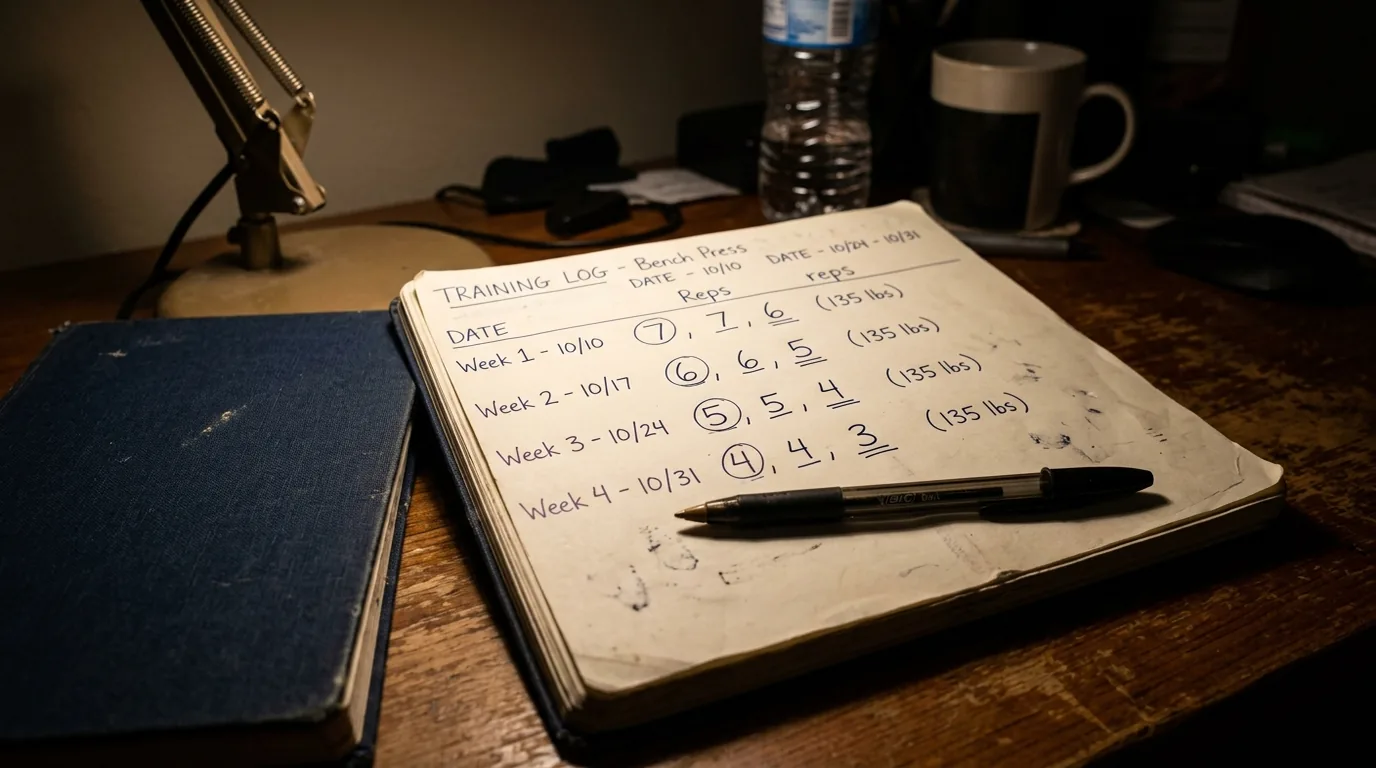
The key metric to track is your Week 3 top-set rep count on each lift across consecutive cycles. A healthy TM progression looks like this: your rep count stays relatively stable or dips slightly as the weight increases, but never collapses. When you see a consistent downward trend in rep counts — three or more cycles in a row where your + set performance is declining — that’s not noise. That’s the shape of a TM that has outgrown your current capacity.
The app’s tracking also surfaces a subtler warning sign: the gap between your Week 1 and Week 3 performance. In a well-calibrated training max, you should be hitting meaningfully more reps on the Week 1 top set (65%/75%/85%) than on Week 3 (75%/85%/95%). As your TM inflates, that gap compresses — Week 1 starts to feel almost as hard as Week 3 because the percentages are no longer representative of where your actual max sits.
Acting on the Data Rather Than Waiting to Fail
The traditional approach is reactive: you miss reps, you accept the plateau, you reset. Train531’s tracking enables a proactive approach. By reviewing your rep trend before the start of a new cycle, you can identify a downward trajectory two or three cycles before you’d actually fail a set.
A three-cycle declining rep trend on the overhead press — even if you’re still technically completing your sets — is actionable information. You can choose to reset before you hit the wall, rather than after. That’s a fundamentally different relationship with your programming, and it’s the difference between managing your training and being managed by it.
The Bottom Line
A 5/3/1 plateau is not a failure of effort. It’s a predictable consequence of a training max that has grown faster than the underlying strength it’s supposed to represent. The program’s built-in solution — the training max reset — is one of its most underutilized features, typically because lifters treat it as a concession rather than a tool.
Wendler’s reset protocols are simple. The hard part is knowing when to use them. That’s where consistent data tracking changes the equation. When you can see three cycles of declining performance in a chart rather than feel it through accumulated frustration, the decision to reset becomes analytical rather than emotional.
Reset earlier than you think you need to. Build the next several cycles on a TM that’s honest. The numbers you hit six months from now will justify it.
Try Train531 Free
AI-powered 5/3/1 coaching. 10 workouts free, no credit card required.
Download on the App Store