5/3/1 SSL Template Explained: What It Is and How to Run It
Learn exactly what the 5/3/1 SSL (Second Set Last) template is, how to program it, when to use it over FSL, and why it builds serious strength.
SSL is one of the most misunderstood supplemental templates in Wendler’s system — partly because 5/3/1 Forever doesn’t spell it out the way newer lifters expect, and partly because most online discussions devolve into “just do FSL instead.” That’s a shame, because SSL is a genuinely useful tool when you understand what it’s actually doing.
This guide covers the mechanics, the math, the weekly structure, and the honest trade-offs so you can decide whether SSL belongs in your next training block.
What Is SSL in 5/3/1?
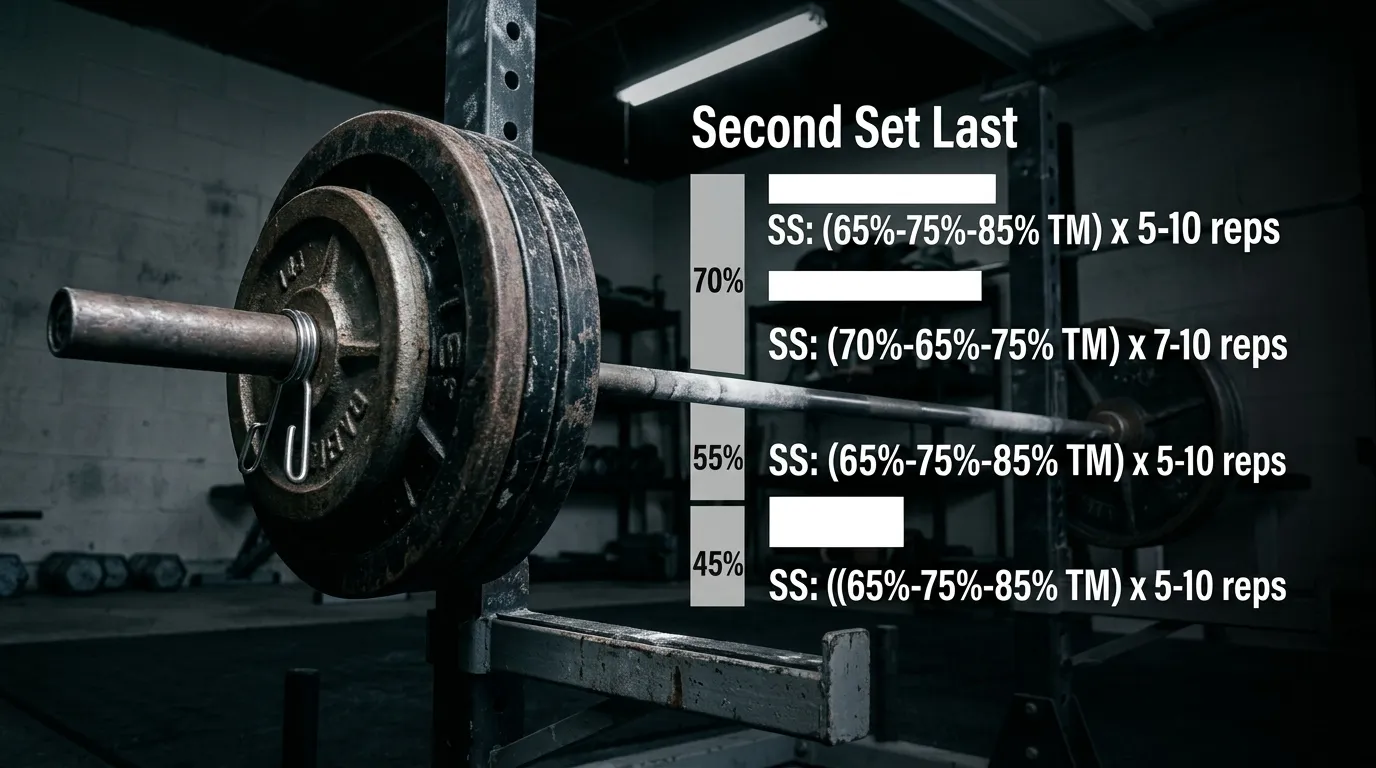
SSL stands for Second Set Last. It’s a supplemental work protocol that appears in 5/3/1 Forever. The name describes exactly how it works: you take the weight from your second main work set and use it for your supplemental volume — typically 5 sets of 5 reps.
To understand why that matters, you need to remember how the three main work sets are structured each week:
- Week 1 (5s week): 65%, 75%, 85%
- Week 2 (3s week): 70%, 80%, 90%
- Week 3 (5/3/1 week): 75%, 85%, 95%
The “second set” each week is the middle percentage — 75%, 80%, or 85% depending on the week. That’s the weight you carry into your 5×5 supplemental block.
Compare that to FSL (First Set Last), which uses the lowest percentage of the week (65%, 70%, or 75%). SSL runs heavier across the board, which is the whole point.
SSL Week-by-Week: The Numbers
Here’s how SSL plays out across a standard 3-week leader cycle, using a 300 lb training max as an example:
A few things stand out immediately. First, by Week 3 your SSL sets are running at 85% of your training max — that’s serious weight for 5×5. Second, the load climbs meaningfully week over week, which creates a natural progression arc within the cycle itself.
Does SSL Use AMRAP Sets?
This is the question that trips up most people new to SSL, and the forums are full of conflicting answers.
The short version: SSL is typically run as a leader template, and leader cycles in 5/3/1 Forever use 5s PRO — meaning your main work sets are capped at the prescribed reps, no AMRAP. You do not push the top set for max reps when running a standard SSL leader block.
The AMRAP (PR set) belongs to anchor cycles, where you’re peaking and testing your strength. If you’ve seen SSL paired with an AMRAP in a specific template (the Strength Challenge in Beyond 5/3/1 is one example), that’s a deliberate programming choice for that context — not the default.
Note: If you’re unclear on the leader/anchor distinction, the 5/3/1 Glossary breaks down both concepts cleanly. Getting that framework right makes every template decision easier.
SSL vs. FSL: The Practical Difference
Both SSL and FSL are leader-cycle supplemental templates. Both use 5×5. The difference is the load.
| FSL | SSL | |
|---|---|---|
| Supplemental weight | First set (65–75% TM) | Second set (75–85% TM) |
| Intensity | Moderate | High |
| Volume stress | Lower | Higher |
| Recovery demand | Manageable | Significant |
| Best for | Building work capacity, deload-adjacent | Strength emphasis, higher intensity tolerance |
FSL is more forgiving. You can run it for multiple consecutive cycles, layer in more accessory work, and recover without much drama. SSL is harder — the 5×5 at 80–85% in Week 2 and Week 3 is genuinely taxing, especially on the squat and deadlift.
For a deeper breakdown of how these two templates compare — including when to pick one over the other — see the FSL vs BBB vs SSL comparison guide.
Who Should Run SSL?
SSL suits lifters who:
- Have a solid training base and handle high-intensity volume without breaking down
- Want to build strength rather than hypertrophy as the primary adaptation
- Are running a focused 1–2 cycle leader block before moving into an anchor
- Have their training max set conservatively enough that 85% TM doesn’t represent a near-max effort
It’s less appropriate for:
- Newer lifters still learning movement patterns under load (the fatigue accumulation is unforgiving)
- Anyone whose training max is set too aggressively — SSL at a bloated TM is a fast road to a stall or injury
- Lifters with high overall training stress who need supplemental work to be recovery-friendly
Warning: If your training max isn’t conservative — meaning your top set AMRAP regularly produces only 1–2 reps — SSL will grind you into the ground. Get your TM right before adding SSL’s intensity. The 5/3/1 Training Max Calculator can help you dial that number in properly.
How to Structure an SSL Block
A standard SSL leader cycle looks like this:
Main Work (5s PRO)
Three sets at the prescribed percentages for the week, capped at the programmed reps. No grinding, no AMRAP.
Supplemental Work (SSL)
5 sets × 5 reps at the second-set weight. Rest fully between sets — this isn’t a conditioning circuit. On Week 3, you’re doing 5×5 at 85% TM. Take the rest you need.
Assistance Work
Keep it reasonable. SSL already generates significant fatigue. A push/pull/single-leg structure with moderate volume is appropriate — choosing the right assistance work becomes especially important here because you don’t have a lot of recovery budget left after the main and supplemental work.
Cycle Length
Run SSL for 1–2 leader cycles (3–6 weeks), then transition to an anchor cycle where you drop the supplemental volume and add PR sets and/or Joker sets.
Progression and What Comes Next
After completing an SSL leader block, you add weight to your training max using the standard 5/3/1 increments (+5 lb upper, +10 lb lower) and move into your anchor. The anchor is where you cash in the strength built during the leader — PR sets, Joker sets, and testing your actual capacity.
If you stall — meaning your AMRAP reps drop cycle over cycle or you’re grinding sets that should move cleanly — that’s a signal to reset your training max before running another leader. Knowing when to reset is one of the most underrated skills in long-term 5/3/1 programming.
SSL in Practice: A Sample Squat Day (Week 2)
To make this concrete, here’s what a Week 2 squat day looks like with SSL, using a 300 lb training max:
Warm-up: Bar × 10, 135 × 5, 165 × 5, 195 × 3
Main Work (5s PRO):
- 210 lb × 3
- 240 lb × 3
- 270 lb × 3
SSL Supplemental:
- 240 lb × 5 (×5 sets)
Assistance: Pull (rows or chin-ups), Single-leg/core work
That’s a lot of volume at 80% TM. You’ll feel it. That’s the point.
Running SSL Without Manual Tracking
Keeping track of SSL percentages, week-to-week weight changes, and training max progression manually is tedious — and the margin for error is real. Miscalculate your second-set weight or forget to update your TM after a cycle and the whole structure breaks down.
Train531 handles all of it automatically: SSL percentages, plate math, progression tracking, and the transition between leader and anchor cycles. The AI coach also monitors your AMRAP performance and flags when your training max needs adjusting — so you’re not guessing whether to push forward or reset.
If you’re running SSL seriously, automated tracking isn’t a luxury. It’s how you make sure the program is actually working.