Training Guide
5/3/1 for Masters Lifters: Strength Training After 40, 50, and Beyond
How older lifters can use the 5/3/1 program for long-term strength gains. Templates, recovery strategies, and smart tracking tools for masters athletes.

There’s a version of strength training that gets louder as you age — more volume, more intensity, more everything. Most people who’ve been under a bar for twenty years know exactly where that road leads: the physio’s table.
Then there’s Jim Wendler’s 5/3/1. A system built on a principle that runs counter to everything the fitness industry sells: leave something in the tank. Train consistently. Build over months and years, not weeks.
For masters lifters — let’s call it anyone training seriously after 40 — this isn’t just good philosophy. It’s the only sustainable philosophy. If you’re still squatting and pulling in your 50s and 60s, you already know that recovery doesn’t work the way it did at 25. Your joints have a longer memory. A bad training week can cost you three good ones.
5/3/1 was built, almost accidentally, to solve exactly this problem. Here’s how to run it intelligently as an older lifter, and how to set up your tools so the program works for you rather than against you.
Why 5/3/1 Is the Perfect System for Longevity
Most strength programs are built around maximalism: maximum frequency, maximum volume, maximum intensity. They work — for a while. For younger lifters with rapid recovery and a long runway of training years ahead of them, grinding near-maximal weights every session produces results.
For masters lifters, that same approach produces inflammation, nagging injuries, and eventually a forced layoff that wipes out months of progress.
5/3/1 operates on a different logic entirely. The foundational concept is the Training Max (TM): you never base your working weights on your true one-rep max. Instead, you use 90% of that number as your ceiling. Your working sets — the 5s, 3s, and 1+ sets — are percentages of that already-reduced number.
What this means in practice: you’re training at intensities that are genuinely sub-maximal for most of your sessions. Week one uses sets at 65%, 75%, and 85% of your TM. Week two steps up to 70%, 80%, and 90%. Week three peaks at 75%, 85%, and 95% — that final 1+ set at 95% of your TM is the culmination of each wave. Then you reset and cycle again.
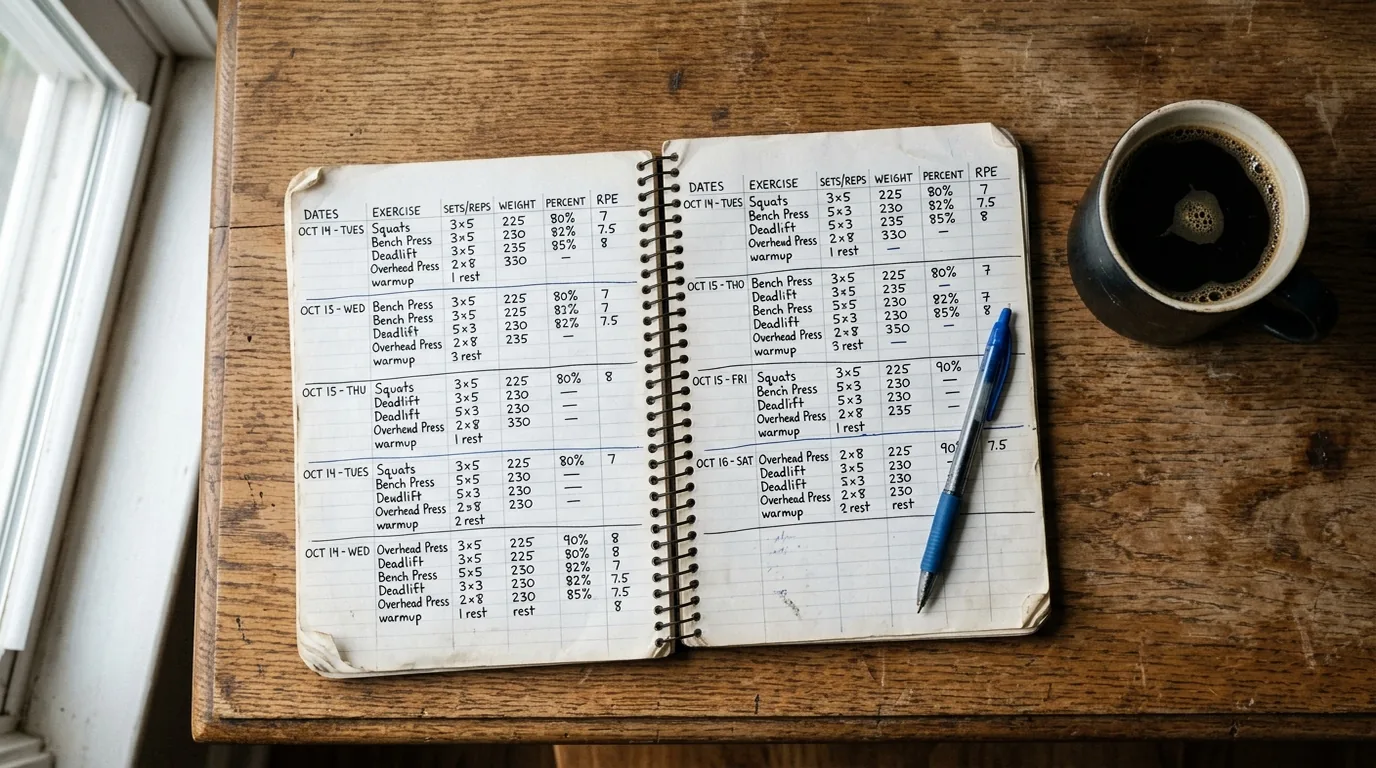
For the masters lifter, this structure delivers two things that are genuinely hard to find in a single program:
Progressive overload without accumulated damage. Because you’re never maxing out, you’re not repeatedly taxing your central nervous system or your connective tissue at peak intensity. The slow, conservative percentage increases — typically 5 lbs per cycle on upper body, 10 lbs on lower — mean your tendons and joints adapt at a pace that roughly matches your muscle adaptations.
Built-in autoregulation through the rep PR set. The final set of each main lift is performed for as many reps as possible (AMRAP). On a good day, you push it. On a day when your hips are stiff and your sleep was poor, you stop at the prescribed minimum and move on. The program accommodates your reality without requiring you to abandon it.
Wendler has been explicit about this for masters athletes: start your Training Max lower than you think it should be. If you think your squat TM should be 315, use 275. The first few cycles will feel easy. That’s the point. You’re building a base, not testing your limits. The PRs come later, and they come reliably.
Modifying the Schedule: 2-Day and 3-Day Templates
The standard 5/3/1 setup is four training days per week — squat, bench, deadlift, and overhead press each get their own session. For many masters lifters in their 40s who are recovering well, this is still viable. But it’s worth reconsidering the assumption that four days is the baseline.
The honest question isn’t “can I train four days?” — it’s “am I recovering between sessions?”
If your squat day leaves you with 48+ hours of meaningful soreness, or if your knees are consistently stiff going into your next lower-body session, you’re accumulating fatigue faster than you’re dissipating it. More training is not the solution.
The 3-Day Template
A three-day rotation is often the right starting point for lifters in their 50s and beyond. The four main lifts still get trained, but because 5/3/1 requires all four lifts to complete a full wave, a 3-day schedule takes four weeks to cycle through all of them — one lift per session, rotating in order across your available training days.
A practical structure might look like:
Week 1: Squat / Bench / Deadlift
Week 2: OHP / Squat / Bench
Week 3: Deadlift / OHP / Squat
Week 4: Bench / Deadlift / OHP
Each lift still runs its prescribed percentages on schedule. You lose no programming integrity — you just add more recovery time between sessions. The wave runs four weeks rather than three, but the quality of each session is higher, and every lift receives equal frequency across the cycle.
The 2-Day Template
For lifters managing genuine joint issues, significant life stress, or a sport season alongside their strength work, the 2-day template is not a compromise — it’s a strategy.
Pair the lifts into two full-body sessions:
Day 1: Squat + Bench
Day 2: Deadlift + OHP
Train those two days with at least two full rest days between them. You can still run all four main lifts through their full 5/3/1 cycles. You’ll make meaningful strength progress. You’ll have time to recover. And you’ll still be lifting in five years.
The key principle across all templates is that the frequency serves the recovery, not the other way around. Too many lifters wear a four-day schedule as a badge of commitment. More sessions per week is not inherently more serious training — for a masters lifter, it’s often just more inflammation.
The Role of Conditioning for the Older Lifter
Wendler divides conditioning into two categories: Easy Strength Conditioning (ESC) and Hard Conditioning. For masters lifters, getting this balance right matters more than it does for younger athletes — both for cardiovascular health and for recovery management.
Easy Conditioning: Your Recovery Tool
Easy conditioning is low-intensity, aerobic-zone work that you can perform every day without meaningful fatigue accumulation. Walking, easy cycling, swimming, or a slow sled push. Wendler calls this “building the aerobic base,” and for older lifters it serves a critical second function: it actively aids recovery by promoting blood flow and reducing systemic inflammation.
The target is roughly 30–45 minutes of work you could maintain a conversation through. Done four to six days per week, this kind of conditioning improves work capacity, supports heart health, and keeps the body mobile between lifting sessions. It doesn’t compete with your strength work. It complements it.
If you’re doing nothing between training days currently, start here. A daily 30-minute walk is not glamorous. It also happens to be one of the most consistent patterns across lifters who are still training hard at 65.
Hard Conditioning: Use It Strategically
Hard conditioning — sprints, hill runs, loaded carries, assault bike intervals — has its place. But for masters lifters it needs to be programmed with deliberate restraint.
The rule of thumb from Wendler’s programming: one hard conditioning session for every two or three easy sessions. Not the other way around. And hard conditioning should be scheduled away from your most demanding lifting days — not the day before a heavy squat session.
The practical risk for older lifters is using hard conditioning as a proxy for toughness while undermining the strength training that’s the actual goal. A brutal circuit two days before deadlift day doesn’t make you a harder worker. It makes your deadlift session worse and your joints angrier.
For masters lifters, conditioning exists to support the lifting — not to compensate for it, not to prove something.
Tech for Masters: Why Apple Watch Tracking Matters
There’s a common assumption that serious lifters don’t need training apps — that a notebook and a chalk board are enough. For many experienced athletes, that’s partially true for programming knowledge. But for data collection and long-term trend analysis, it’s not enough.
This matters more, not less, as you age.
The Data You Can’t Track With a Notebook
Heart rate response to training is one of the most reliable indicators of recovery status and overall readiness. If your resting heart rate is elevated by 5–8 BPM over your baseline, you’re not fully recovered. If your heart rate is climbing unusually high on a set that normally feels moderate, your system is under stress. These aren’t things you’ll notice without data — they’re things you’ll rationalize away.
An Apple Watch worn through a training session captures this passively. You don’t have to think about it. You lift, and afterward you have a record of how your cardiovascular system responded.
How to Track 5/3/1 on Apple Watch
The friction point for most lifters is that tracking a barbell program on a smartwatch is awkward. Generic workout apps require manual navigation between sets, don’t understand percentage-based programming, and don’t connect your heart rate data to your actual training loads.
Train531 is built specifically to solve this. The Apple Watch app delivers your working weights directly to your wrist — calculated from your Training Max — so you never need to pull out your phone between sets. You see the weight, the prescribed reps, and the set number. You log it with a tap. Your heart rate data is captured automatically through the Watch’s native sensors and tied to that specific session.
Over time, this creates a data set that a notebook never could: your actual cardiovascular response to each training session, alongside your weights and rep counts, across months of training. For a masters lifter managing recovery carefully, this is the difference between guessing at your readiness and knowing it.
What this looks like in practice:
- Warm up. Your Watch shows your current heart rate in the background.
- Navigate to your first main lift. The prescribed weight is displayed — calculated from your TM, no math required.
- Complete your sets. Log each one with a tap.
- Review your session summary: total volume, heart rate data, rep PR flagged if you hit one.
The workflow removes the cognitive overhead that slows down real training sessions. You’re not toggling between calculator apps and notebooks. You’re lifting.
The Bigger Picture: Training as a Long-Term Project
For masters lifters, the value of structured tracking compounds over time in a way that younger lifters often don’t appreciate yet. Knowing your squat was 245 lbs last September and it’s 270 lbs today — and that your heart rate at equivalent effort has dropped — tells you something that pure feel cannot. You’re getting stronger and more efficient. The training is working.
Conversely, if your rep PRs have stalled for two cycles and your heart rate at submaximal loads is creeping up, that’s a signal. Not to push harder — to audit your sleep, your conditioning load, or your Training Max.
The best strength training app for intermediate and masters lifters isn’t necessarily the one with the most features. It’s the one that removes friction from the tracking process so that your historical data is actually complete. Gaps in your training log are gaps in your self-knowledge.
Putting It Together
5/3/1 for masters lifters isn’t a scaled-down version of the program. It’s the program used with the intelligence that comes from experience. The principles are the same: sub-maximal Training Max, slow progression, autoregulation through rep PR sets. What changes is the application.
Start with a conservative Training Max — lower than feels right. Choose a training frequency that allows genuine recovery between sessions. Integrate easy conditioning as a daily practice and reserve hard conditioning for strategic placement in your week. And build a tracking system that gives you real data over real time.
The lifters who are still pulling respectable weights at 60 and 65 aren’t there because they were tougher at 40. They’re there because they were smarter. They treated every training cycle as a deposit into a long-term account, not a withdrawal against their body’s reserves.
5/3/1, run correctly, is exactly that kind of program. The only question is whether your tools are set up to support that approach — or working against it.
Try Train531 Free
AI-powered 5/3/1 coaching. 10 workouts free, no credit card required.
Download on the App Store