5/3/1 Accessory Work: A Complete Programming Guide
Learn how to program 5/3/1 accessory work by lift day, template, and training goal — without accumulating junk volume or stalling your main lifts.
Accessory work is where most 5/3/1 lifters either get it right or quietly sabotage themselves. The main lift percentages are fixed. The supplemental template is chosen. But the accessories? That’s three to five exercises per session where lifters routinely pile on too much volume, pick the wrong movements, or treat the whole category as an afterthought. This guide cuts through the noise.
What “Accessory Work” Actually Means in 5/3/1
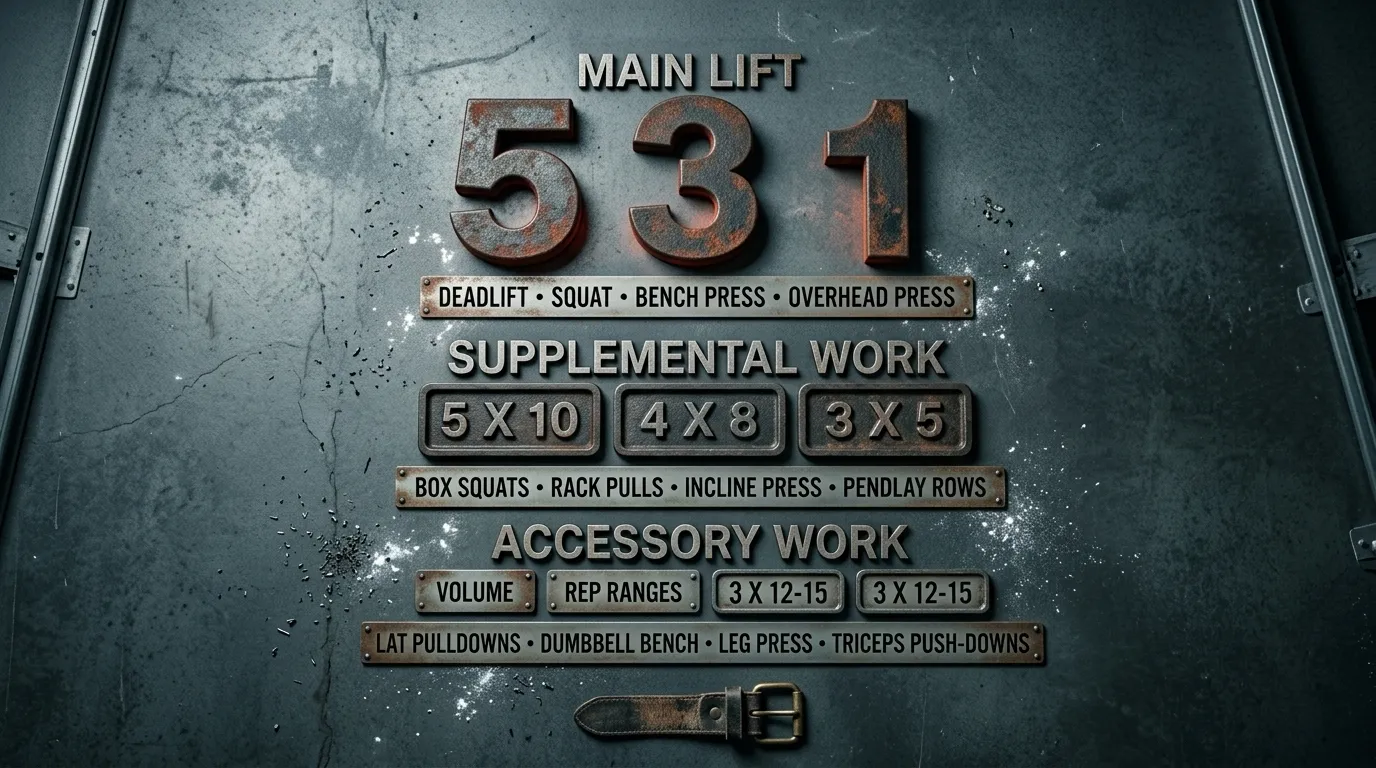
Before programming anything, it helps to be precise about terminology. In Wendler’s system, a typical training day has three distinct layers:
- Main lift — the primary movement (squat, bench, deadlift, overhead press) performed with 5/3/1 percentages and an AMRAP set
- Supplemental work — additional volume on or near the main lift (FSL, BBB, SSL, etc.)
- Accessory work — everything else: the push, pull, and single-leg/core work that fills out the session
The confusion usually starts because people conflate supplemental and accessory work. If you’re running 5/3/1 BBB, your five sets of ten at 50–60% of your training max is supplemental work — not accessories. Accessories come after that. Understanding the distinction matters because it directly affects how much volume you can sustainably add.
Note: If you’re new to the program’s structure, the 5/3/1 Glossary defines every term precisely — TM, PR set, Leader/Anchor, and more — before you start layering in accessories.
The Three Categories: Push, Pull, Single Leg/Core
Wendler’s framework for accessories is deliberately simple: pick one push, one pull, and one single-leg or core movement per session. That’s it. Three categories, one exercise each, typically 3–5 sets of 10–15 reps.
This structure exists for a reason. The main lift and supplemental work are already taxing the primary movers. Accessories are meant to address weak points, build supporting musculature, and create balance — not to add a second workout on top of the first.
Push Accessories
Push accessories target the pressing muscles not fully covered by the main lift. On a bench day, that might mean dips, incline dumbbell press, or tricep pushdowns. On a press day, it could be dumbbell lateral raises, close-grip bench, or push-ups.
The key principle: push accessories should complement, not duplicate. If your main lift is the overhead press, adding a heavy dumbbell shoulder press as your accessory is redundant. Choose movements that hit the same muscles from a different angle or emphasize a weak point in the chain.
Common push accessories by day:
| Main Lift | Push Accessory Options |
|---|---|
| Squat | Leg press, Bulgarian split squat |
| Bench | Dips, incline DB press, tricep pushdowns |
| Deadlift | Leg press, hack squat |
| Press | DB lateral raises, close-grip bench, push-ups |
Pull Accessories
Pull accessories are arguably the most important category in 5/3/1. The four main lifts are heavily push- and hinge-dominant. Without deliberate pulling volume, you accumulate a structural imbalance that eventually shows up as shoulder pain, poor posture, or a stalled bench.
Wendler has been consistent on this: rows and pull-up variations should be present in nearly every session. Chin-ups, barbell rows, dumbbell rows, face pulls, and cable rows are all valid. The goal is to match or exceed your pressing volume over the course of a week.
For lifters running a four-day template, this means pull accessories appear on all four days — not just upper body days. Rows on squat day and deadlift day are not unusual; they’re recommended.
Single Leg and Core Accessories
Single-leg work addresses the bilateral deficit that squats and deadlifts can mask. Lunges, step-ups, Bulgarian split squats, and single-leg Romanian deadlifts build unilateral strength, improve hip stability, and reduce injury risk — especially relevant for masters lifters where joint health and movement quality become increasingly important.
Core accessories in 5/3/1 lean toward anti-movement patterns: planks, ab wheel rollouts, Pallof presses, and hanging leg raises rather than endless crunches. The core’s primary job in the big lifts is to resist movement, so training it that way carries over directly.
How Volume Changes by Supplemental Template
The biggest programming mistake with accessories is treating them as a constant regardless of what supplemental template you’re running. They shouldn’t be.
Accessories on BBB
Boring But Big is volume-intensive by design — five sets of ten at 50–60% training max is a significant workload. When you’re running BBB, accessories need to be dialed back. Wendler’s own recommendation is to keep them light and brief: a few sets of pull-ups or rows supersetted with the BBB sets, and minimal additional work afterward.
Trying to run heavy accessory work on top of BBB is a fast path to overtraining. The supplemental work is the stimulus. Accessories are maintenance.
Accessories on FSL
First Set Last is less demanding than BBB, which gives you more room for accessory volume. Three to five sets of 10–15 reps per category is reasonable. This is a good template for lifters who want to prioritize hypertrophy in their accessories without the fatigue ceiling that BBB imposes. See the FSL vs BBB vs SSL comparison for a full breakdown of how these templates differ in practice.
Accessories on SSL
Straight Sets Last (SSL) sits between FSL and BBB in terms of intensity. Accessory volume should be moderate — similar to FSL but with attention to recovery, since SSL sets are heavier than FSL percentages.
Tip: A useful rule of thumb — the harder your supplemental work, the lighter and shorter your accessories should be. If you’re grinding through BBB sets, three sets of bodyweight pull-ups is a better accessory choice than three sets of heavy barbell rows.
Programming Accessories by Day: Practical Examples
Here’s how a four-day 5/3/1 week might look with accessories properly integrated. This assumes a moderate supplemental template (FSL) and intermediate training age.
Day 1 — Squat
- Main: Squat 5/3/1 + AMRAP
- Supplemental: FSL 5×5
- Push: Leg press — 3×10
- Pull: Dumbbell rows — 3×12
- Single leg/core: Ab wheel rollouts — 3×10
Day 2 — Bench
- Main: Bench 5/3/1 + AMRAP
- Supplemental: FSL 5×5
- Push: Dips — 3×10
- Pull: Chin-ups — 3×8–10
- Single leg/core: Pallof press — 3×12 each side
Day 3 — Deadlift
- Main: Deadlift 5/3/1 + AMRAP
- Supplemental: FSL 5×5
- Push: Leg press — 3×10
- Pull: Barbell rows — 3×10
- Single leg/core: Hanging leg raises — 3×12
Day 4 — Press
- Main: Overhead press 5/3/1 + AMRAP
- Supplemental: FSL 5×5
- Push: DB lateral raises — 3×15
- Pull: Face pulls — 3×15
- Single leg/core: Bulgarian split squat — 3×8 each leg
This isn’t a prescription — it’s a template. The movements can and should be swapped based on equipment, weak points, and individual recovery capacity.
Choosing Accessories Based on Weak Points
The most effective accessory programming is targeted, not generic. If your squat is losing the battle at the bottom, more leg press isn’t the answer — pause squats or box squats in the supplemental slot, combined with single-leg work and core stability accessories, will address the actual problem.
Common weak point patterns and the accessories that address them:
Bench lockout weakness: Tricep pushdowns, close-grip bench, board press variations
Squat depth/bottom position: Pause squats, goblet squats, hip flexor mobility work
Deadlift off the floor: Deficit deadlifts, Romanian deadlifts, hamstring curls
Press overhead stability: Face pulls, band pull-aparts, rotator cuff work
General upper back weakness (affects everything): More rows. Always more rows.
The push/pull/legs accessory guide goes deeper on exercise selection by movement pattern if you want a more granular breakdown.
How to Progress Accessories Over Time
Accessories don’t follow the same rigid progression as the main lifts, but they shouldn’t be static either. A few approaches work well:
Double progression: Pick a rep range (say, 3×8–12). Once you can hit the top of the range on all sets, add weight and drop back to the bottom of the range.
Volume progression: Keep weight constant and add sets or reps over a Leader/Anchor cycle. Useful for bodyweight movements like pull-ups and dips.
Autoregulation: Adjust based on how the main work felt. If the AMRAP set was a grinder, pull back on accessory volume that session. Progressive overload still applies to accessories — it just doesn’t need to be as systematic as the main lift.
What doesn’t work: adding weight every week without structure, or running the same accessories at the same weights for months without any progression stimulus.
What to Avoid
A few patterns consistently derail accessory programming in 5/3/1:
Too many exercises. Three categories, one exercise each. Five isolation movements after your main work is bodybuilding programming bolted onto a strength program. Pick one thing per category and do it well.
Ego-loading accessories. Accessories are not the place to test your dumbbell row max. Keep the weights moderate and the form strict. Heavy, sloppy accessories on fatigued muscles is how injuries happen.
Ignoring pulling volume. The most common structural mistake in 5/3/1 accessory programming. If you’re pressing three or four times a week and rowing once, you’re building an imbalance.
Changing accessories every week. Consistency matters. Run the same accessories for a full Leader block (typically six weeks) before evaluating whether they’re working. Novelty is not a training stimulus.
Letting the Program Breathe
One of the harder lessons in 5/3/1 is that the program works when you let it work. The main lifts drive strength. The supplemental work builds volume. The accessories fill gaps. When lifters start treating accessories as the primary driver of progress — loading them up, rotating constantly, chasing pump — the whole structure breaks down.
The complete 5/3/1 program guide covers the full philosophy behind why the program is built this way. The short version: trust the structure, keep accessories in their lane, and focus your energy on the AMRAP sets that actually move the needle.
Take the Guesswork Out of Accessory Programming
Knowing the principles is one thing. Applying them consistently across every training cycle — adjusting volume for your supplemental template, rotating exercises at the right time, tracking whether your accessories are actually addressing your weak points — is where most lifters fall short.
Train531 handles this automatically. The AI coach prescribes your accessory work based on your training history, the strength ratios between your lifts, and your stated goals, so you walk into every session knowing exactly what to do, not just what percentages to hit. Try it free for 30 days.